
Why is Success Still the Exception?
In their 2023 Harvard Business Review article „How AI Will Transform Project Management“ [1] authors Antonio Nieto-Rodriguez and Ricardo Viana Vargas state “Every year, approximately $48 trillion are invested in projects. Yet according to the Standish Group, only 35% of projects are considered successful. The wasted resources and unrealized benefits of the other 65% are mind-blowing.”
The 2020 Forbes Insights and MIT Sloan Management Review [2] finds that 47% of agile transformations fail, 65% of the failures are terminal, i.e the business closes or goes bankrupt.
Success is Possible
For the past 20 years we have coached challenged or failing projects and helped them to succeed. The first 10 years we had been using Scrum almost exclusively. Our observation of the limitations of this approach, let us to combine Agile, Kanban, Design Thinking and OKR’s for the next 10 years. Those years showed projects benefitting tremendously from the combination of the methods. It had clearly worked but the approach was not yet systematic. It was the right time to categorize the various improvement measures, assess their impacts and take account of possible variations.
The Search for Patterns
Basic assumptions
There is merit in the combination of methods. Exclusive usage of one method is unlikely to be the answer, especially since some are obviously complementary in nature and no single method covers the whole spectrum.
We found expert opinions in support of this point of view.
.. it is important to address the current market need by integrating design thinking approaches to the Agile development approach.
D. Ready, C. Cohen, D. Kiron, and B. Pring [3]
… seeking to leverage the benefits of continuous improvement … your job is to pick and choose the specific elements from each practice that work well for your teams …
Jeff Gothelf, Lean vs. Agile vs. Design Thinking [4]
In future blogs we will expand on this topic and provide additional arguments but for the sake of brevity we will leave it for now as is.
Approach
In the attempt to find categories for the improvement measures we had used, we would
- abstract from concrete measures,
- attempt to find a method-agnostic language and
- identify patterns.
EAgLe Discovered
Introduction
We came up with the name EAgLe to stand for „Evolutionary Agile & Lean“ as we had combined Agile and Lean. Design Thinking did not fit into the acronym so we had to omit it from the name but not from our practice. The EAgLe System we had set out to discover should be a systematic, continuous improvement approach combining Agile, Lean, Design Thinking, OKR’s with a focus on objective, measurable improvements. EAgLe was originally intended to improve existing projects.
As it turned out, the results of our analysis do not „just“ apply to improvements efforts but also to development practices, methods, approaches and frameworks.
In the sequel, we will present EAgLe at the team level. There is also a team-of-teams level but that will be the subject of a future blog.
The EAgLe Circle
We could associate the measures we had used in past projects to eight fundamental components (categories). One can think of these components as team capabilities. As intended, they are method-agnostic. Since there are various ways in which one could sort them, we depict them in a circle, the EAgLe circle.
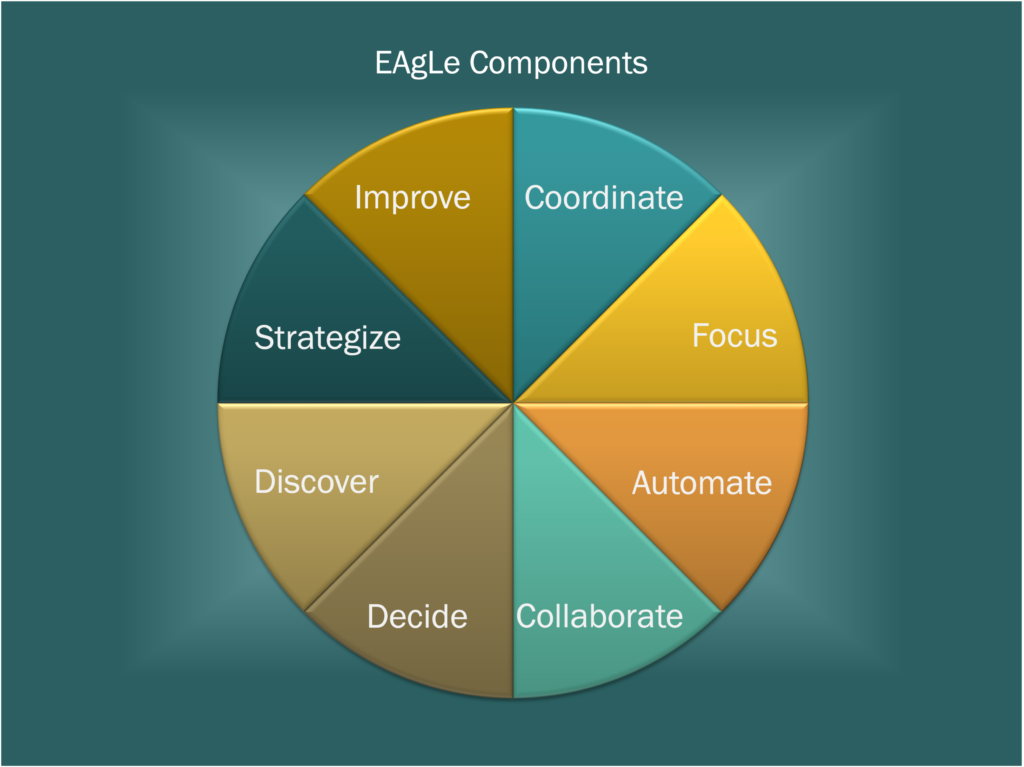
- Coordinate: Avoid bottlenecks and load peaks and make early feedback possible by proper scheduling of tasks and resources.
- Focus: Set priorities, create a shared understanding of them and act accordingly.
- Automate: Identify and automate re-occurring manual tasks.
- Collaborate: Works in groups on specific tasks in order to produce better results.
- Decide: Make optimal group-based decisions by implementing a transparent process.
- Discover: Discover those features that create the most benefit for the customers and the own enterprise.
- Strategize: Choose the right goals that meet the customer needs.
- Improve: Improve systematically and regularly.
The EAgLe 8-by-8
For each component, we identified further eight sub-components that are still method-agnostic. „Eight circles and one that governs them all.“ if you may.
One can put these circles to various uses:
- for truly systematic, method-agnostic continuous improvement,
- to analyze or compare methods, development approaches and to spot their gaps,
- as a guiding light in combining methods.
There will be more on this in future blogs. But for now, let’s go back to the EAgLe components.
The EAgLe Mantra
The eight EAgLe components appear to be quite natural. Using the metaphor of a team taking a journey, the purpose of each of the EAgLe circles can be summed up as follows in a „Lord of the Rings“ style.
| Verse | Dimension |
| One to determine the destination, | Strategize |
| one to determine the path, | Discover |
| one to make the right decisions, | Decide |
| one to stay on the path, | Focus |
| two to travel even faster, | Coordinate |
| Automate | |
| one to support each other, | Collaborate |
| one to become better in every aspect, | Improve |
| and one to rule them all. | EAgLe |
EAgLe Showcase
We’ll show EAgLe at work with the example of a legacy-industry cross-functional development team using a hybrid (agile, traditional) approach at the start of the improvement process. After 24 months of continuous improvements and training sessions, the following practices had been selected for the eight EAgLe components:
- Coordinate: Kanban
- Focus: Kanban, best-practice prioritisation schemes, probabalistic forecasting
- Automate: Pragmatic Project Automation, CI/CD and project-specific automations
- Collaborate: User Stories and other agile elements, focus on cross-functional collaboration
- Decide: Participatory Decision Making, Opportunity Solution Trees
- Discover: Lean UX Canvas, Customer Journey Map, Continuous Discovery Habits, User Story Mapping
- Strategize: OKR’s
- Improve: Agile Retrospectives, Kaizen Events, Continuous Retrospectives
This is just intended as an overview. In the weeks to follow, there will be more blogs on the subject of EAgLe.
References
[1] Antonio Nieto-Rodriguez and Ricardo Viana Vargas, How AI Will Transform Project Management, [https://hbr.org/2023/02/how-ai-will-transform-project-management], 2023
[2] D. Ready, C. Cohen, D. Kiron, and B. Pring, “The New Leadership Playbook for the Digital Age,” MIT Sloan Management Review, January 2020
[3] Shyam Gawade and Vidyavati Ramteke 2021 J. Phys.: Conf. Ser. 1964 042009
[4] Jeff Gothelf, Lean vs. Agile vs. Design Thinking: What You Really Need to Know to Build High-Performing Digital Product Teams, Sense and Respond Press, 2017